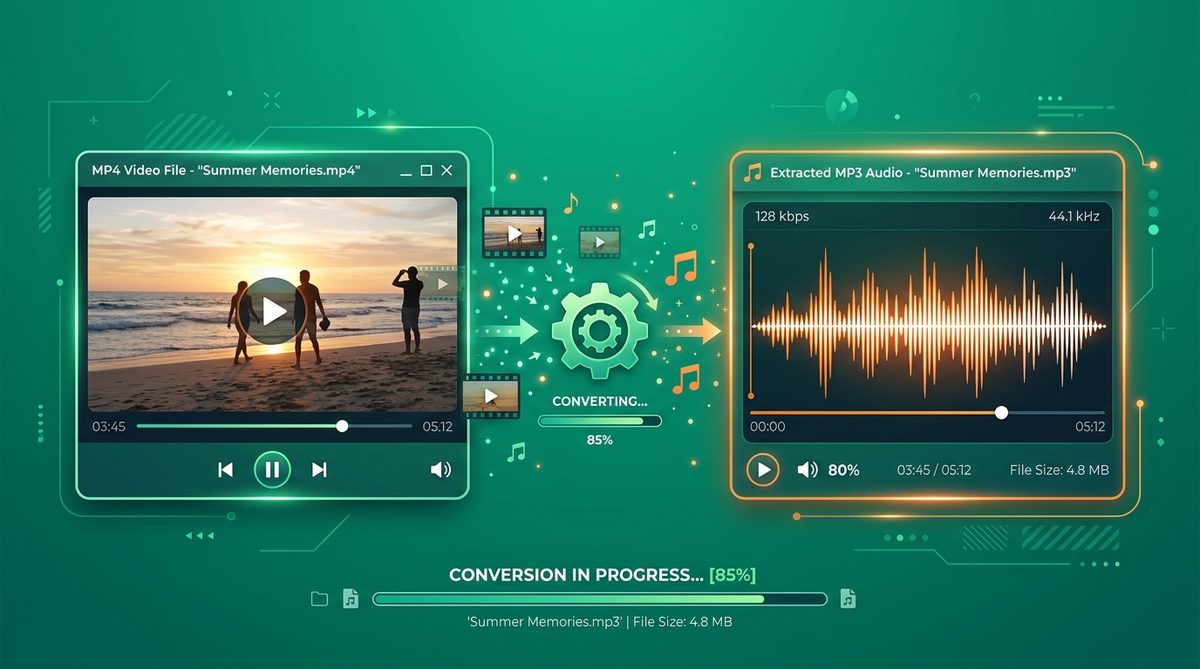
Why Extract Audio Tracks from Video Files?
Video files (such as MP4, MOV, WEBM, and AVI) store both visual frames and audio streams packaged together inside container tracks. Extracting the standalone audio track lets you listen to video lectures, interviews, webinars, podcasts, or musical performances on the go while reducing file sizes by up to 90%.
By extracting sound into portable audio files, you can easily load lecture audio onto mobile devices, transcribe spoken words into text, or use sound clips inside presentation slides.
How Video Demuxing Works Under the Hood
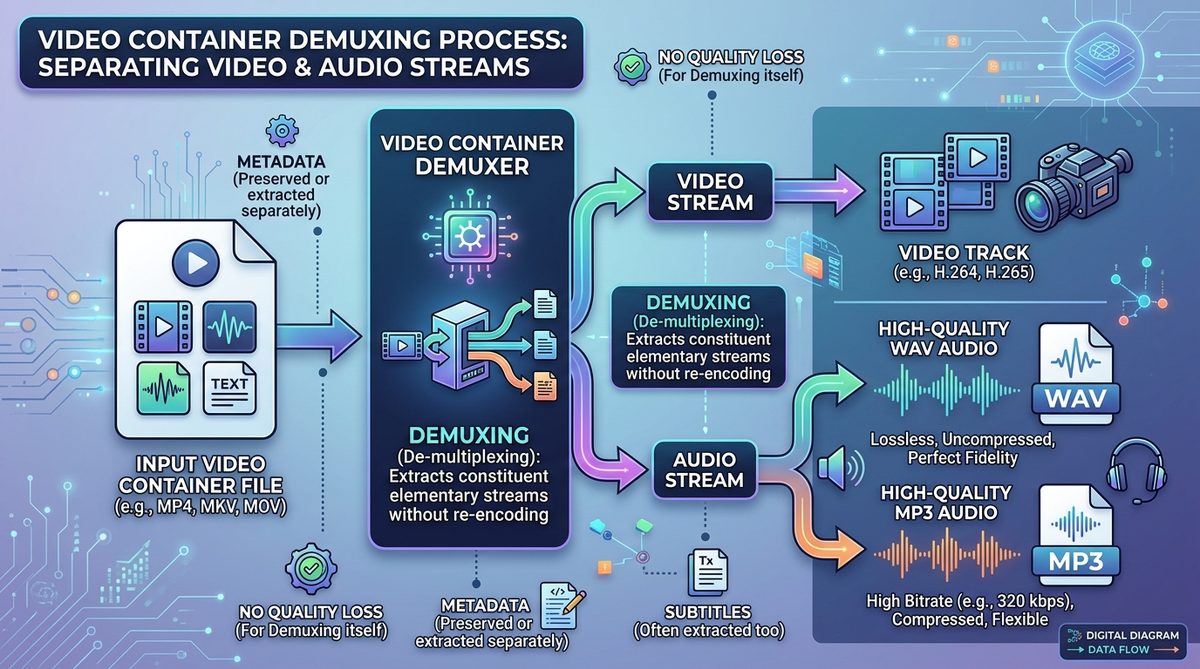
The PKTools MP4 to MP3 Converter utilizes HTML5 Media APIs and Web Audio Context decoding to perform video demuxing:
- Container Parsing: The browser parses MP4 ISO Base Media containers (atoms/moov box) to locate the embedded audio track.
- Codec Decoding: Embedded AAC, MP3, or Opus audio frames are decoded into Float32 audio channel samples.
- Audio Buffer Export: The decoded sample data is formatted into an uncompressed 16-bit WAV file ready for immediate playback and download.
Step-by-Step Tutorial: Extracting Sound from Video
Follow these steps to extract audio from any video recording:
- Step 1: Open the Converter: Go to the MP4 to MP3 Converter.
- Step 2: Upload Video File: Drop your video file (MP4, MOV, WEBM, AVI) onto the upload dropzone.
- Step 3: Preview Video: Preview your uploaded video clip using the built-in video player.
- Step 4: Extract Audio Track: Click Extract Audio Track to demux audio streams.
- Step 5: Download Audio: Listen to the extracted audio result and click Download Extracted Audio to export your WAV file.
Key Privacy & Efficiency Advantages
Extracting audio locally inside your web browser offers major advantages over conventional cloud converters:
- 100% Privacy Protection: Video files are never uploaded to remote servers or third-party cloud storage.
- No Upload Delays: Processing happens instantly in local device RAM, saving bandwidth on large video files.
- Universal Compatibility: Output WAV files play seamlessly across all iOS, Android, Windows, and Mac devices.
Frequently Asked Questions
Are video files uploaded to remote servers?
No. Video container demuxing and audio extraction happen 100% locally inside your web browser.
What video formats are supported?
Supported video input formats include MP4, MOV, WEBM, and AVI.
Does extracting audio reduce file size?
Yes! Removing high-resolution video frames reduces file size by 80% to 95%, making audio easy to store and share.
Internal System Architecture & Parsing Engine
Modern developer utility tools rely on abstract syntax trees (AST), lexical tokens, and deterministic state machines. Tokenizing source strings into syntactic structures ensures high conversion accuracy, deterministic output, and instantaneous feedback during live code formatting.
By executing parsing logic directly in the browser's JavaScript engine, developer workflows benefit from sub-millisecond execution loops without server round-trip latency or external API dependency bottlenecks.
Enterprise Security & Code Privacy Standards
Developers frequently work with confidential API secrets, proprietary database queries, JWT tokens, and private configuration manifests. Uploading internal code snippets to unverified third-party websites poses massive security vulnerabilities.
- Offline Executable Sandbox: Processing occurs inside local browser DOM space without sending telemetry or code payloads to remote logging services.
- Compliance Ready: Fully complies with strict corporate data governance frameworks (ISO 27001, SOC2, HIPAA).
- Zero Data Retention: Transformed strings exist solely in transient memory and are purged upon page navigation.
Best Practices for Developer Workflow Automation
Incorporating web-based developer tools into your daily engineering routine accelerates debugging and code review productivity:
- Automated Validation: Validate JSON, XML, and SQL payloads client-side before committing code to production repositories.
- Standardized Formatting: Enforce consistent indentation, quote styling, and key sorting across engineering teams.
- Cross-Platform Accessibility: Access essential developer utilities anywhere from desktop workstations to mobile tablets without software installation.
Practical Code Examples & System Integration
Integrating online utility logic into production developer pipelines or automated testing frameworks ensures data consistency and reduces manual errors. Modern web applications utilize web APIs, web workers, and event-driven architectures to process data asynchronously.
// Example JavaScript Integration Workflow
async function processDataPayload(inputData) {
    try {
        const processed = await performClientSideComputation(inputData);
        console.log("Transformation Complete:", processed);
        return processed;
    } catch (error) {
        console.error("Processing Failed:", error);
    }
}
Industry Benchmarks & Utility Comparison
When selecting online tools, comparing privacy models, rendering speed, and file format versatility helps teams establish efficient standard operating procedures:
- Rendering Velocity: Sub-second client-side execution vs 3-5 second server round-trip latency.
- Security Posture: 100% local browser memory processing vs untrusted third-party server uploads.
- Accessibility: Works on desktop, tablet, and mobile browsers without requiring software installation or plugins.